
Great white sharks are among the ocean’s most successful predators, but their hunting ability depends on much more than sharp teeth. Scientists have discovered that these sharks combine several highly developed senses to locate prey, even in dark or murky water.
From detecting faint scents to sensing tiny electrical signals produced by living animals, every part of their biology helps them survive. This article explains how great white sharks use their remarkable sensory systems, why the famous blood myth is misleading, and how their anatomy has evolved for life at the top of the food chain.
Smell is only part of the story

Great white sharks have an excellent sense of smell, and a large portion of their brain is devoted to processing odors carried through seawater. This helps them detect potential food over long distances.
However, sharks cannot simply smell a drop of blood from miles away, as popular myths often claim. Scientists explain that smell is only one part of a much more complex hunting system.
They can feel movement in the water
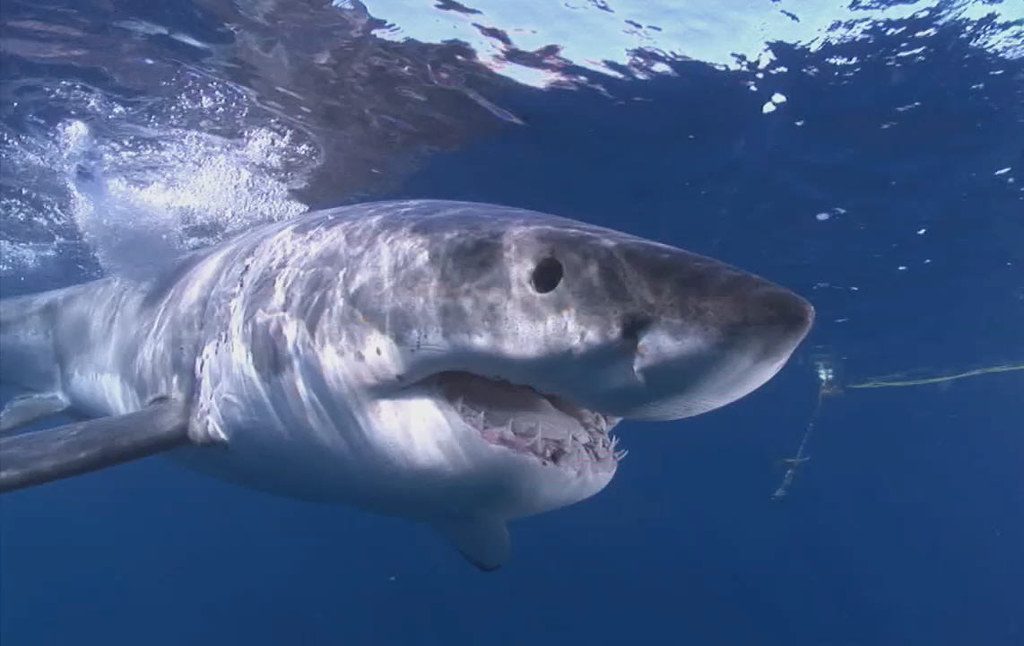
Great white sharks also use a sensory system called the lateral line. This network of receptors detects vibrations and pressure changes created by swimming animals.
Even when visibility is poor, the lateral line helps sharks determine the direction and movement of nearby prey. It allows them to track activity that might otherwise go unnoticed.
A sixth sense detects electricity

One of the shark’s most remarkable adaptations is the ampullae of Lorenzini. These tiny jelly filled pores around the head detect weak electrical fields generated by muscle contractions and heartbeats.
During the final moments of a hunt, this electroreception system allows a shark to locate prey with incredible precision, even if it is buried beneath sand or hidden from view.
Vision and hearing complete the hunt

Great white sharks also depend on excellent eyesight, especially in clear water. Their eyes help identify the size, shape, and movement of potential prey before an attack.
Hearing plays an important role as well. Sharks can detect low-frequency sounds that travel long distances through water, helping them locate struggling or injured animals before they come into view.
Every sense works together

Scientists believe sharks use their senses in sequence rather than relying on only one. Smell and hearing help detect prey from farther away, vision becomes more important as the shark approaches, and electroreception guides the final strike.
This combination of sensory systems makes great white sharks highly adaptable hunters in many different ocean environments, from shallow coastal waters to the open sea.
Evolution created an efficient predator

The great white shark’s sensory abilities have developed over millions of years. Each adaptation improves its ability to locate food while reducing wasted energy during a hunt.
Understanding how these senses work helps replace myths with science. Rather than relying on a single extraordinary ability, great white sharks succeed because multiple advanced senses work together with remarkable efficiency.
Leave a Reply