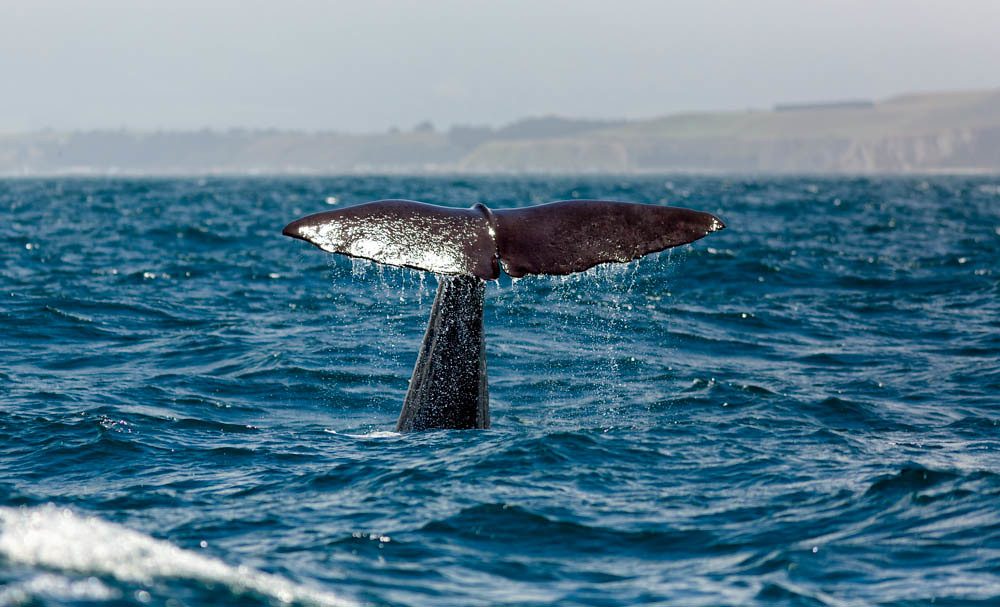
Imagine making a sound that another whale could detect from 44 miles away. Male sperm whales may be capable of doing exactly that. New research into sperm whale calls has revealed the remarkable power and rhythm of sounds known as slow clicks. These low-frequency signals can exceed 200 decibels underwater and may travel across about 70 kilometers of deep ocean under suitable conditions.
Even more surprisingly, males can keep the clicks in a steady rhythm despite leaving several seconds between them. Scientists think these sounds are designed for long-range communication, but they still do not know exactly what information the whales are sending across the ocean.
Male sperm whales produce unusually slow clicks
Sperm whales produce several kinds of clicks, and they do not all serve the same purpose. Some are connected with finding and tracking prey. Others, known as codas, are associated with social communication. Slow clicks stand apart because they are extremely powerful, relatively low in frequency, and produced at unusually long time intervals. The new research focused on understanding what makes these sounds so different.
There is also a major clue in who produces them. Slow clicks are known to be made by male sperm whales. Earlier research using recording tags found that males produced these sounds in situations that did not match normal feeding behavior. That helped build the idea that slow clicks may be communication signals rather than a way to locate prey. The new study tested that possibility by examining the power, rhythm, and possible range of the sounds.
The whales keep an extremely slow rhythm
One of the most unusual discoveries involves timing. Researchers found that slow clicks occur at rates of about 0.1 to 0.3 hertz. In simple terms, a male may leave several seconds between one click and the next. The supplied material describes gaps of roughly 5 to 10 seconds. Despite these long pauses, the whales can maintain a remarkably regular rhythm.
That makes the behavior different from many other rhythmic animal signals. The researchers found that sperm whale slow clicks operate about an order of magnitude more slowly than other rhythmic communication signals studied in mammals and birds. Yet the whales still maintain their timing. The combination of very slow rhythm, extreme sound levels, and long-range transmission is what makes the behavior so unusual.
Slow clicks may travel about 70 kilometers

The distance these sounds may cover is perhaps the most striking finding. Researchers combined measurements of the sperm whale sounds with models showing how sound travels through the ocean. Under the deep water conditions used in their model, the slow clicks had an estimated active range of about 70 kilometers. That is roughly 44 miles.
This does not mean every slow click will always travel exactly 70 kilometers. The figure is a modeled estimate under particular ocean conditions. Water depth, temperature, background noise, and other factors can change how far a sound remains detectable. The study describes the range as reaching up to about 70 kilometers rather than giving it as a fixed distance for every whale and location.
These are extremely powerful communication sounds
Sperm whales were already famous for producing some of the most powerful biological sounds known. Their normal echolocation clicks can reach even higher source levels than the slow clicks examined in the new study. These powerful echolocation sounds help the whales search for prey in deep, dark water.
Slow clicks are different because the new research treats them as communication signals. The measured slow clicks had average apparent source levels above 200 dB re 1 µPa peak to peak. The researchers concluded that this makes them the loudest known communication signals produced by mammals.
A huge nose helps sperm whales make the sounds

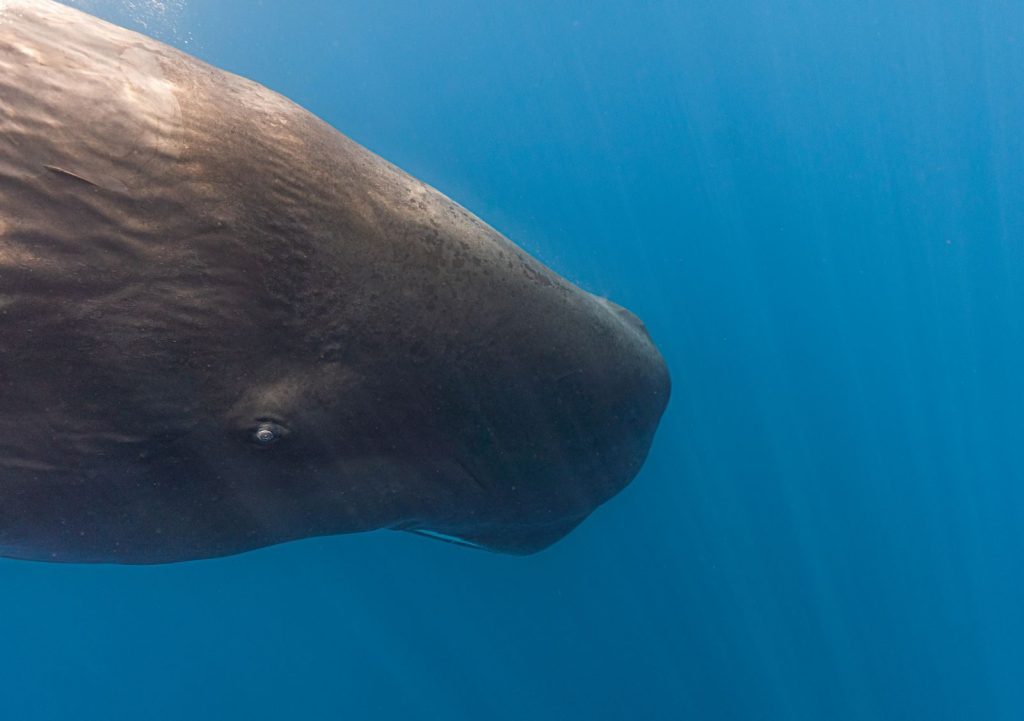
Sperm whales have an enormous sound-producing system inside their heads. In mature males, the nasal complex can make up around one-third of the animal’s body length and reach a mass greater than 5 tons. The researchers describe it as the largest sound production system in the animal kingdom.
The system includes structures called phonic lips and large spaces containing spermaceti oil. Together, these structures help sperm whales produce their powerful clicks. The huge size of this system is especially noticeable in adult males, who have larger sound-producing structures than females.
Scientists still need to learn what the clicks mean

The biggest unanswered question is also the simplest. Why are male sperm whales making these sounds? The evidence strongly supports the idea that slow clicks have properties suited for long-range communication. Their low frequency, extreme volume, steady rhythm, and potential range all point in that direction. Earlier research also found that the sounds were not linked with the movements and clicking patterns expected during feeding.
But showing that a sound is suited for communication is not the same as understanding its message. The 2026 researchers say the communication function ultimately needs stronger testing through detailed observations or playback studies. Scientists would need to understand how other whales respond to the signals to learn more about the information being exchanged.
Featured Image: “Sperm Whale Diving” by stewartbaird is licensed under CC BY-NC-ND 2.0
Leave a Reply