
A tiger shark slowly circling a person can look like a predator preparing to attack. But shark behavior is not that simple. Scientists cannot watch a circling tiger shark and know exactly what the animal is thinking. Sharks may approach people for different reasons, and their behavior can vary even between members of the same species.
Tiger sharks are powerful predators that naturally investigate their surroundings and hunt many kinds of prey. They are also among the shark species most often linked with serious bites involving humans. Still, close approaches do not automatically mean an attack is coming. Understanding these encounters requires separating what scientists have actually observed from assumptions about a shark’s intentions.
Tiger sharks are powerful and flexible predators

Tiger sharks are large predators found across warm and tropical waters. Their scientific name is Galeocerdo cuvier. Unlike a predator that depends heavily on one food source, tiger sharks have a broad diet. This ability to feed on many different things has helped give them a reputation as highly opportunistic hunters. They can move through coastal and open ocean environments while searching for feeding opportunities.
Their size and feeding habits also make close encounters with people important to take seriously. The International Shark Attack File places tiger sharks with white sharks and bull sharks as the three species most often associated with serious unprovoked bites. The database currently lists more than 100 confirmed unprovoked tiger shark incidents, including fatal cases. That does not mean tiger sharks normally hunt humans. Human encounters remain rare compared with the huge amount of time people spend swimming and surfing in the ocean.
Circling does not prove a shark plans to attack

Watching a shark swim around a person can create an obvious question. Is the animal deciding whether the person is food? Scientists cannot answer that question simply by watching the shark’s path. Hawaii’s Division of Aquatic Resources explains that researchers still have major gaps in their understanding of shark behavior, especially the rare behaviors connected with bites on people.
Individual sharks can also behave very differently. Researchers who spend long periods observing tiger sharks have seen some animals approach cautiously while others behave more boldly. That variation makes simple rules unreliable. A circle around a swimmer does not automatically translate into one specific intention. Saying the shark is measuring someone’s size, weakness, or position before deciding to attack would therefore go beyond what scientists can confidently determine from the movement alone.
Circling can happen before serious encounters

Although circling does not prove hunting intent, it should not simply be dismissed as harmless behavior either. The International Shark Attack File divides unprovoked bites into several broad patterns. One less common type is described as a bump and bite encounter. In these incidents, a shark may circle a person and sometimes make physical contact before eventually biting.
These encounters differ from the more common hit-and-run pattern. In a hit-and-run incident, a person often does not see the shark before a quick bite occurs, and the animal normally leaves afterward. Bump and bite encounters can involve more sustained behavior. Researchers believe some may involve feeding or antagonistic behavior rather than simple mistaken identity.
Scientists cannot easily determine a shark’s motive
One of the biggest problems in studying shark bites is that researchers rarely see the entire event. An incident may last only seconds. Witnesses can be frightened or focused on helping the person involved. Visibility underwater may also be poor. Scientists often have to reconstruct what happened from limited information afterward.
Hawaii shark researchers point to this problem directly. In most cases, scientists have little or no information about what the shark was doing immediately before a bite. That makes it extremely difficult to determine what caused the animal to approach or what motivated the final interaction.
Humans are not normal tiger shark prey

Tiger sharks naturally eat many kinds of marine animals. Their normal diets can include fish, sea turtles, birds, and marine mammals. Humans are not a regular part of that natural diet. Researchers have also pointed out something interesting about tiger sharks. These animals can spend considerable time in waters also used by people, yet bites remain rare compared with the number of opportunities sharks have to encounter humans.
This helps challenge the idea that every large shark approaching a person is searching for a meal. NOAA also warns against sensational descriptions of shark encounters. An interaction may be called an attack online even when nobody was bitten. That kind of language can make shark behavior seem more predictable and aggressive than the scientific evidence supports.
Shark behavior is more complicated than viral videos suggest
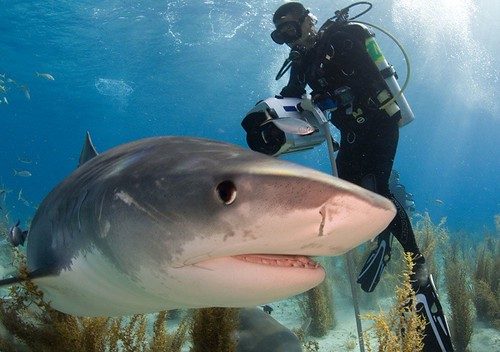
A short video can show exactly where a shark swims, but it cannot show what the animal is thinking. That is the key problem with describing a circling tiger shark as testing a human for food. The movement is visible. The intention behind it is not.
Scientists continue studying tiger shark movements, feeding ecology, habitat use, and interactions with humans. Tracking research has revealed that some tiger sharks travel enormous distances. Individual animals can also show different movement patterns and use different habitats throughout the year.
Featured Image: “Tiger shark” by WIlly Volk is licensed under CC BY-NC-SA 2.0
Leave a Reply