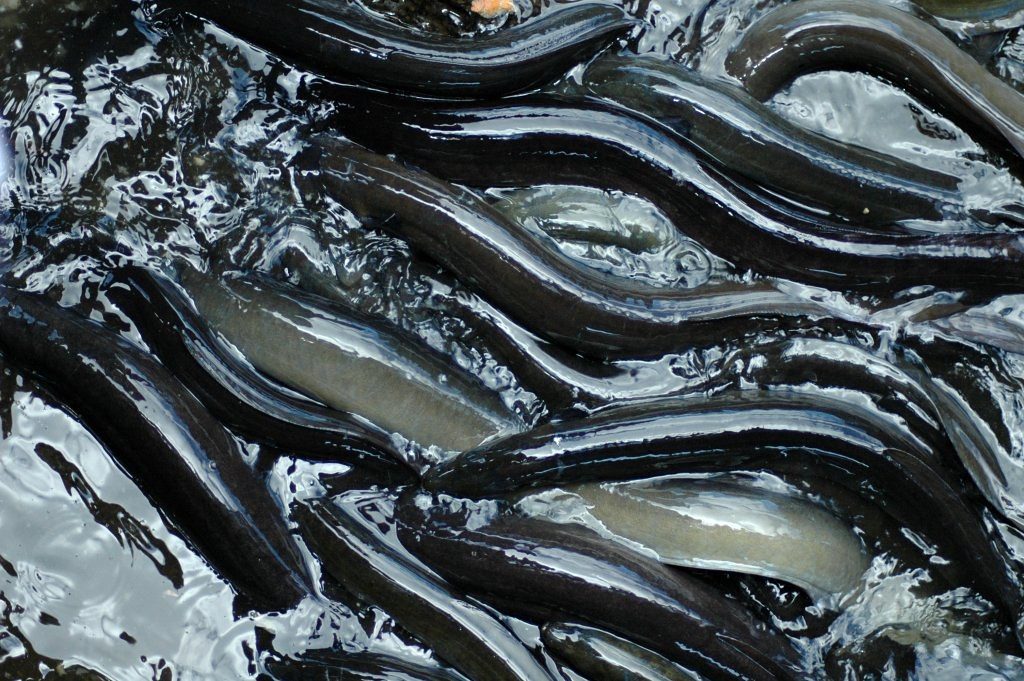
Scientists documented an extraordinary gathering of more than 100 adult Volta’s electric eels, Electrophorus voltai, in a small lake connected to Brazil’s Iriri River. Instead of behaving exclusively as solitary predators, the eels repeatedly worked together to concentrate large schools of small fish.
Researchers first witnessed the behavior in 2012 and returned in 2014, eventually recording 72 hours of observations. The repeated encounters provided evidence that the unusual group hunting was a genuine feeding strategy rather than a single accidental event.
Thousands of fish were herded together
Around dawn and dusk, the eels became active and began swimming in a large circle around schools of small tetras. Their movements gradually forced thousands of 1 to 2-inch fish into increasingly dense groups.
The eels also pushed the concentrated prey from water about 12 feet deep into areas around 3 feet deep. By restricting the fish’s available space, the group created conditions where smaller teams of electric eels could move in for an attack.
Groups of 2 to 10 launched attacks
Once the prey had been concentrated, groups containing approximately 2 to 10 electric eels separated from the larger aggregation. They surrounded the tightly packed fish before producing synchronized high-voltage electrical discharges.
Researchers observed about 5 to 7 high voltage attacks during each hunting session, with the overall ritual lasting roughly an hour. Social predation is uncommon among fishes, making the repeated coordination especially noteworthy.
One eel can generate up to 860 volts
Volta’s electric eel is capable of generating electrical discharges reaching 860 volts, the highest measured voltage produced by any known animal. Researchers identified this remarkable ability while describing Electrophorus voltai as a distinct electric eel species in 2019.
Electric eels produce electricity using specialized organs occupying much of their elongated bodies. Strong discharges are used for hunting and defense, while weaker electrical signals can contribute to navigation and communication.
8,600 volts is theoretical, not measured

The 8,600-volt figure needs an important qualification. C. David de Santana of the Smithsonian explained that if 10 Volta’s electric eels each discharged their maximum 860 volts simultaneously, they could theoretically produce 8,600 volts.
Scientists did not directly measure an 8,600-volt combined discharge during these hunts. The researchers specifically identified direct measurement of synchronized electrical attacks as something they wanted to investigate, so presenting 8,600 volts as an observed reading would be inaccurate.
The shocks sent prey out of the water
The synchronized attacks produced dramatic effects. Researchers reported that shocked tetras were thrown from the water, then fell back stunned and largely motionless, allowing the electric eels to capture them much more easily.
This strategy allowed the predators to capture numerous fast-moving fish during one feeding event. That differs substantially from their usual solitary strategy, in which electric eels typically approach individual resting fish and disable them with electrical pulses.
Scientists still have major questions
Researchers have so far documented this particular social hunting behavior at one location, so they caution against assuming that groups of Volta’s electric eels routinely hunt this way throughout the Amazon. Their hypothesis is that unusually abundant prey and sufficient shelter may make these gatherings possible.
Another unanswered question is how the animals coordinate their attacks. Electric eels can produce weaker electrical signals for communication, raising the possibility that electrical signaling could contribute to group coordination, but researchers have not yet established exactly how these remarkable synchronized hunts are organized.
Featured Image: “Eel Orgy” by cheetah100 is licensed under CC BY 2.0
Leave a Reply