
A wild American black bear regularly visiting a New Jersey home has drawn attention for doing something surprisingly familiar. Susan Kehoe, a Highland Lakes resident and longtime bear education advocate, calls the animal Mr. Doorman, or Mr. D. In a video shared online, the bear sits beside Kehoe’s open front door while she calmly asks him to close it.
After becoming distracted by something outside, the bear eventually pushes the door shut. The interaction may look like something between a person and a trained pet, but Mr. D remains a wild black bear. The unusual encounter also raises an important question about how bears learn to respond to people they encounter repeatedly.
Susan Kehoe has observed bears for decades

Kehoe has lived around black bears in northern New Jersey for more than 30 years and has become known for documenting her encounters with them. Her videos frequently show bears moving around her property and demonstrate how comfortable some individual animals can become in areas shared with people.
Mr. D is one of the bears that Kehoe says visits her regularly. She gave him the nickname Mr. Doorman because of his unusual habit involving her front door. In the widely shared clip, Kehoe speaks calmly to the bear while he remains immediately outside her home.
Mr. D appears to respond to her request

The video shows Mr. D positioned beside the open door while Kehoe tells him to close it. The bear initially appears distracted by something in the surrounding woods. Kehoe then gets his attention again, after which the animal moves the door until it closes.
It is tempting to interpret the behavior as though the bear understands language exactly as a person would, but the video alone cannot establish that. Animals can learn associations between particular sounds, gestures, and outcomes through repeated experiences. Mr. D’s behavior could therefore reflect familiarity with a repeated cue rather than an understanding of the sentence itself.
Black bears are capable learners

American black bears are adaptable animals with strong learning and memory abilities. Research has shown that bears can learn to solve problems and remember where useful resources are located. Those abilities are particularly valuable because their food availability changes throughout the year.
Bears can also learn from repeated encounters with people. A bear that repeatedly experiences humans without a negative consequence may become less wary around them, a process known as habituation. Food conditioning is different and occurs when an animal learns to associate people or human environments with food. Either situation can increase the chances of close encounters.
New Jersey has a substantial black bear population

Black bears occur across much of northern New Jersey, including the region surrounding Highland Lakes in Sussex County. The state’s forests provide suitable habitat, while residential development means people and bears can sometimes occupy the same areas.
The New Jersey Department of Environmental Protection advises residents to maintain distance from black bears and avoid intentionally feeding them. Officials also recommend securing garbage and other potential food sources because bears that repeatedly obtain food around homes can become increasingly comfortable returning to residential areas.
Close contact with wild bears carries risks
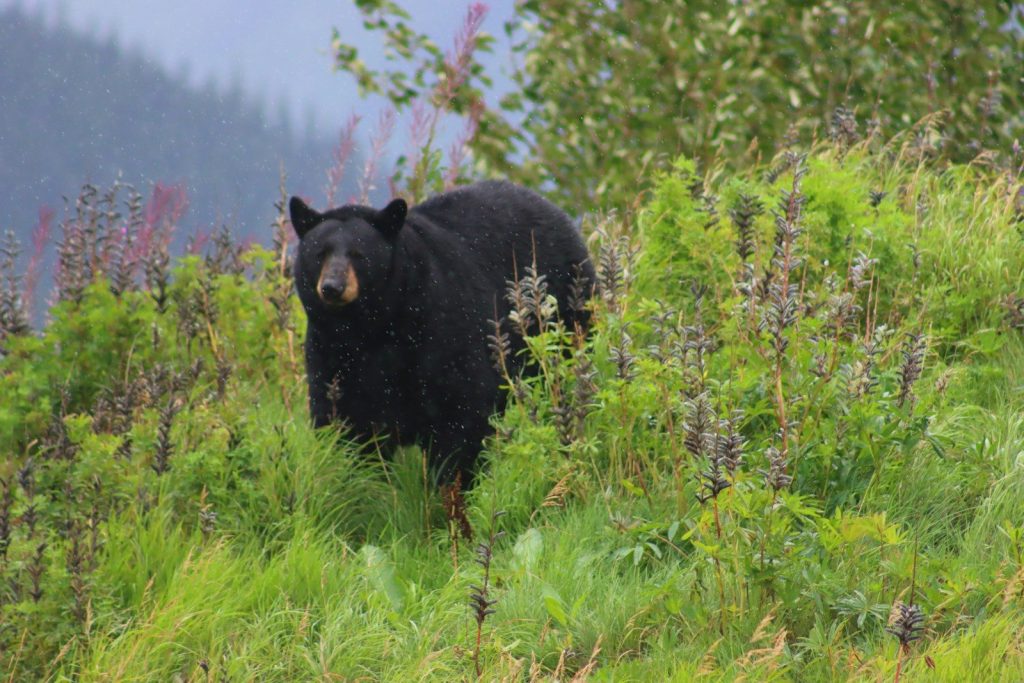
Mr. D’s calm behavior in one video should not be interpreted as evidence that approaching wild black bears is safe. Individual behavior can change depending on circumstances, and even a bear that has previously tolerated a person’s presence remains a powerful wild animal.
Wildlife agencies generally recommend giving black bears an escape route rather than approaching, touching or cornering them. People should also avoid trying to recreate close encounters seen in social media videos. Observing bears from a safe distance reduces risks for people while also helping prevent animals from becoming unusually comfortable around humans.
The door closing behavior has a simpler explanation

The most interesting part of the encounter is not necessarily that Mr. D understands a human command. A more cautious interpretation is that repeated exposure may have allowed the bear to associate Kehoe’s voice or behavior with a particular response. Learning associations like these is well within the abilities of intelligent mammals.
That distinction matters because describing the bear as behaving like a pet can create the wrong impression about wild animals. Mr. D may appear unusually calm and familiar around Kehoe, and the door closing makes for remarkable footage. But he remains a wild black bear, and the safest lesson for viewers is to appreciate the behavior without assuming similar interactions with other bears would end the same way.
Leave a Reply