
The ocean is home to some of the strangest animals on Earth. But among the predators, scavengers and deep-sea oddities are creatures that look almost too beautiful to be real.
From fish that seem to be covered in flowers to tiny animals that glow in the darkness, these five marine creatures show just how creative nature can be.
Leafy seadragon

It looks like a piece of floating seaweed, but the leafy seadragon is actually a fish.
Native to the coastal waters of southern and western Australia, this unusual relative of the seahorse is covered in elaborate leaf-like appendages. They aren’t used for swimming. Instead, they help the animal blend into its surroundings.
The camouflage is so convincing that a leafy seadragon can drift among seaweed and kelp without immediately revealing itself to predators.
It also has a surprisingly unusual way of moving. Instead of relying on its leafy appendages, it uses small, almost transparent fins to propel itself through the water.
Mandarin fish

Few reef fish can compete with the mandarin fish for sheer color.
Its body is covered in vivid blue, orange, green and yellow patterns that make it look almost painted. The tiny fish is found around coral reefs in the western Pacific, where it spends much of its time searching the seafloor for tiny prey.
Its beauty comes with a useful defense.
Mandarin fish produce toxic mucus from their skin, giving predators another reason to leave the colorful little fish alone.
Blue glaucus

The blue glaucus is tiny, but it looks like something from an alien world.
This striking sea slug has a silvery underside and vivid blue coloring, along with finger-like structures extending from its body.
It spends much of its life floating upside down at the ocean’s surface, carried along by currents.
But its delicate appearance is deceptive.
The blue glaucus can feed on venomous creatures such as the Portuguese man o’ war and store their stinging cells. It can then use those stolen defenses against potential predators.
For such a small animal, that’s an impressive survival strategy.
Sea angel
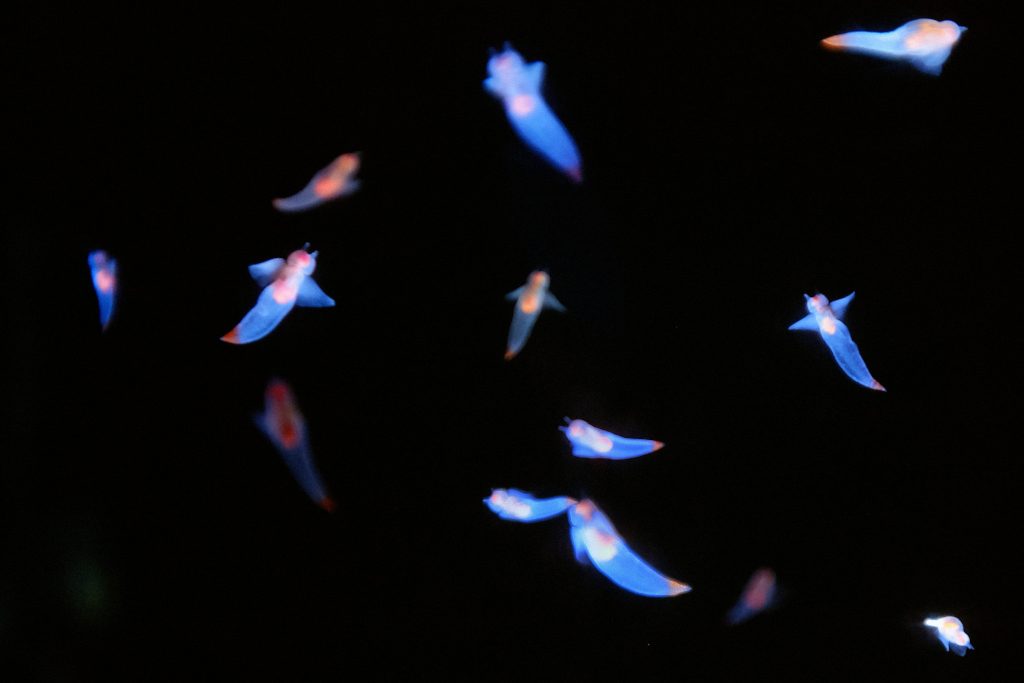
The sea angel sounds like a creature from a fantasy story, and its appearance isn’t far off.
This tiny marine snail has a translucent body and wing-like structures that allow it to glide through the water. Unlike many snails, it doesn’t have a traditional shell once it reaches adulthood.
Despite its graceful appearance, the sea angel is actually a predator.
It hunts another type of tiny marine snail called a sea butterfly, grabbing its prey with specialized structures around its mouth.
Its almost transparent body also allows it to disappear against the surrounding water, making it difficult for predators to spot.
Weedy seadragon

The weedy seadragon may look like it has been decorated with pieces of seaweed.
Its body is covered in irregular appendages that break up its outline, helping it disappear among kelp and underwater vegetation.
Like its leafy relative, the weedy seadragon is found around Australia’s southern coastline.
It is not a powerful swimmer. Instead, it relies heavily on camouflage and gentle movements to avoid attracting attention.
And there is another fascinating detail about these animals: the male carries the eggs.
Females deposit their eggs onto a specialized area on the underside of the male’s tail, where they remain attached until they hatch.
Featured Image: Photo by Karthik B K on Unsplash
Leave a Reply